How to Track Vending Machine Sales Without Spreadsheets
I started tracking my vending machines the same way everyone does: a notebook in the truck, then a Google Sheet I was weirdly proud of for about a week, then a slightly more ambitious Google Sheet with conditional formatting and formulas that broke whenever I added a new product.
Eight months and 10,000+ vends later I can tell you the spreadsheet approach breaks down fast. Not because spreadsheets are bad tools (they're great for a lot of things), but because the data's stale the moment you close the tab, and the discipline of updating it consistently while you're also restocking machines, working a full-time job, and trying to figure out why your Gatorade slot jammed again is just not realistic long-term.
I run two machines in a multi-tenant office building in the Chicagoland area. One drink, one snack. Between Cantaloupe's Seed Live portal, VendSoft, and my own spreadsheet tracking, I've cycled through a bunch of different setups trying to answer the same basic question: what do I need to know before I load the truck?
The actual problem isn't organization
When I first set up my spreadsheet I thought the issue was that I needed a better system: more columns, better formulas, maybe a pivot table. But the real problem was timing. By the time you sit down, open the spreadsheet, enter what you restocked, cross-reference it against what Seed Live is showing you sold, and try to figure out what's running low, you're already behind. The machines don't wait for you to update your spreadsheet.
Takis sell about 3 per day in our snack machine. The slot holds 10. So I've got roughly 3 days before it's empty, and if I'm only looking at my data once a week (which is generous; some weeks it was less, especially during busy stretches at my day job), I'm losing sales on my best product for 2-3 days every single restock cycle. At $2.50 each that's around $35 a month in lost revenue, and that's one product in one machine. Scale that across a route of 20 or 50 machines and you start to see why the guys making real money aren't the ones with the fanciest spreadsheet. They're the ones who know what's happening in their machines before they load the truck.
What your telemetry portal does (and what it doesn't)
If you're running cashless (and in 2026 you really should be), your telemetry provider is already collecting sales data in real time. I use Cantaloupe's Seed Live and it shows me every transaction as it happens. Nayax has a similar portal. The data exists whether you look at it or not.
The problem is these portals are built around transactions, not decisions. Seed Live can tell me I sold 3 Takis today. It can't tell me that at this rate the slot will be empty by Thursday and I should probably move my restock up a day. It doesn't know what I paid for those Takis (about 35 cents, for the record; 86% margin, best product in either machine), so it can't help me figure out which products are actually making money versus just generating revenue that looks good on a dashboard. And it definitely doesn't understand that the person buying Takis at 2pm is probably the same person grabbing a Gatorade on the way back to their desk. If Takis stock out, I might lose that second sale too.
The portal gives you a firehose. What you actually need is the five or six things worth knowing before your next run.
Why I stopped trusting volume numbers
For months I stocked based on what sold the most. More volume, more slots, seems obvious. Then I started actually tracking what each product costs me and the picture shifted in ways I didn't expect. I wrote a full breakdown with all the math in how to calculate vending profit margins, but the short version is: revenue and profit are very different stories. Our drink machine does more revenue. Our snack machine does more profit. I almost made stocking decisions based on the wrong number for three months before I caught it.
The lesson for tracking specifically is that your system, whatever it is, needs to incorporate cost data alongside sales data. A product doing 5 vends a day at 45% margin is less valuable than a product doing 3 vends a day at 87% margin, but you'd never know that from the telemetry portal alone.
Sell-through rates are the thing to watch
This is what I wish I'd focused on from the beginning instead of building increasingly complicated spreadsheets. Every product has a sell-through rate: how many units sell per day in that slot. Once you know that number (and your telemetry portal actually gives you enough data to calculate it, even if it doesn't present it that way), you can figure out roughly when each slot will be empty and plan your restocking around that instead of just going on a fixed schedule.
I used to go every Tuesday whether the machines needed it or not. That's optimizing for the calendar, not the machines. Some weeks Tuesday was too late for Takis and too early for everything else. I'd show up, refill one slot, and realize I didn't bring enough of something else because I hadn't checked the data before loading the truck. Now I roughly know my sell-through rates on the top 8-10 items and plan around when things will actually run out. Some weeks that means going Monday and Thursday. Some weeks I can skip a few days entirely.
The operators I've talked to who run larger routes (20-50+ machines) tend to think about it the same way: it's not about visiting every machine every week, it's about knowing which machines need attention and what they need before you leave the warehouse. That's an information problem, not a logistics problem, and it's the thing spreadsheets handle worst because they're always out of date. At 2 machines I can keep most of this in my head. But the operators I know who've scaled to 10 or 20 machines say that's where it flips. The spreadsheet that worked fine at 5 machines becomes a part-time job at 15, and the tracking problem doesn't scale linearly; it compounds.
Watch for the cliff
When the main tenant in our building moved out in January, weekly revenue dropped from $1,100+ to under $40. I wrote about the full story and what the numbers looked like, but the tracking lesson specifically is this: I didn't catch it fast enough because I was reviewing data weekly instead of daily. If I'd been doing a quick 2-minute check every morning, just glancing at yesterday's total to see if anything looked off, I would've seen the drop on day one instead of day seven. That's a week I could've spent scouting new locations or figuring out my next move instead of sitting on a dead location not realizing it was dead.
Daily doesn't mean deep analysis every day. It means a quick sanity check. Did the machines sell roughly what they normally sell? If yes, move on. If something looks weird, dig in. That habit alone would've saved me a couple weeks of lost time.
Where I've landed
I got tired of stitching together Seed Live, VendSoft, and a spreadsheet to get a picture that should take about 30 seconds: what's selling, what's running low, and what's actually making me money. The information exists across three different tools and none of them talk to each other, so I end up being the integration layer, manually cross-referencing tabs at 10pm when I should be doing literally anything else.
The frustrating part is that the data already exists. Your telemetry knows what sold. Your wholesale invoices know what it cost. Your machine planogram knows what's in each slot. None of these systems talk to each other by default, so you become the glue, and that glue job takes longer the more machines you add, which is backwards. The part of your business that should get easier with scale (information) is the part that gets harder.
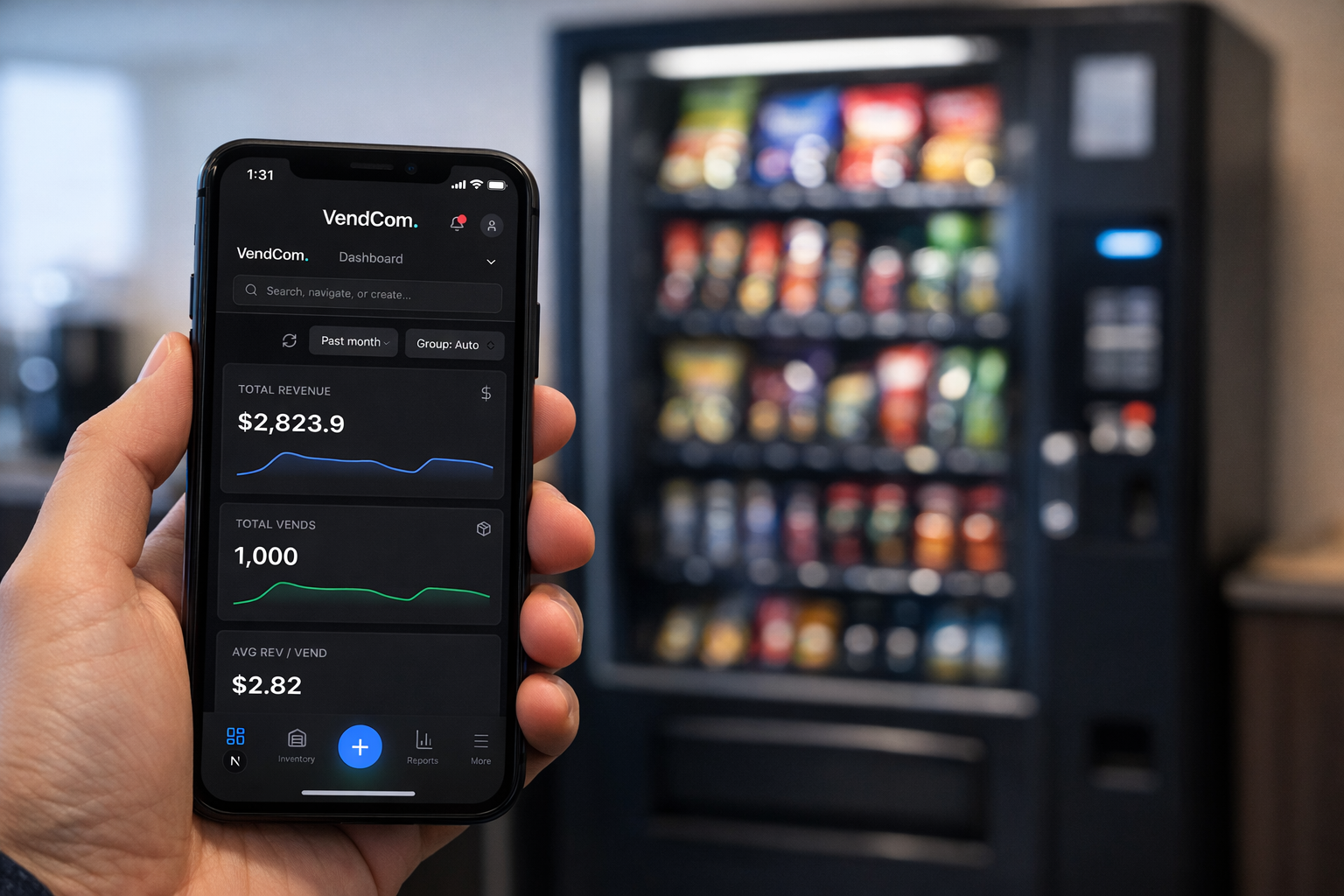
That's actually why I started building VendCom. Not because I wanted to build software, but because the duct-tape setup has a ceiling and I hit it faster than I expected with just two machines. If you're dealing with the same stack of disconnected tools, you already know the feeling.
Either way, the principles work even with imperfect tools: know your sell-through rates, check your data daily (even just a glance), and restock on data not on calendar.
Frequently Asked Questions
How often should I check my vending machine sales data? Daily is ideal if you can make it a 2-minute habit. Pull up your telemetry portal, glance at yesterday's totals, see if anything looks off. The goal isn't deep analysis every day, it's catching anomalies early. That tenant departure I mentioned would've been obvious on day one if I'd been looking.
Can I track vending machine sales from my phone? Your telemetry provider (Cantaloupe, Nayax) has a web portal accessible from any browser. The raw data is there. The gap is turning transaction data into something actionable (what to bring, what to swap, what's underperforming) without exporting to Excel first.
What's the minimum setup to track sales accurately? Cashless readers on every machine (Nayax or Cantaloupe), a way to track your product costs (even a basic spreadsheet to start), and a habit of reviewing what's selling and at what margin at least weekly. The readers are non-negotiable in 2026; they're collecting data whether you look at it or not.
About the Author
Aidan
Runs a vending business in the Chicagoland area. Building VendCom for independent vending operators.
Learn more →Related Posts
How to Calculate Vending Machine Profit Margins
Revenue isn't profit. Here's how I calculate real margins on every product in my vending machines, with actual numbers from 8 months of data.
What I Learned Running Two Vending Machines for 8 Months
$30K revenue, 10,000+ vends, one tenant departure that nearly killed the business. Here's everything I'd do differently.
Nayax vs Cantaloupe: What Independent Operators Actually Need to Know
Two telemetry providers, two portals, one headache. Here's the real difference and how to deal with running both.