What I Learned Running Two Vending Machines for 8 Months
I've been running two vending machines (one snack, one drink) in a multi-tenant office building in the Chicago western suburbs since July 2025. This is everything that happened over those eight months, with real numbers and the thinking behind the decisions I made (and the ones I should've made differently).
This isn't a success story or a cautionary tale; it's both, sometimes in the same week. $30,513 in total revenue, a product education that cost me real money before it started making me real money, and a tenant departure in January that turned a $1,100/week operation into a $37/week one in a matter of days. If you're thinking about starting in vending or you're in your first year and trying to figure out what's normal, this is the kind of data I wish I'd had access to when I was getting started.
The setup
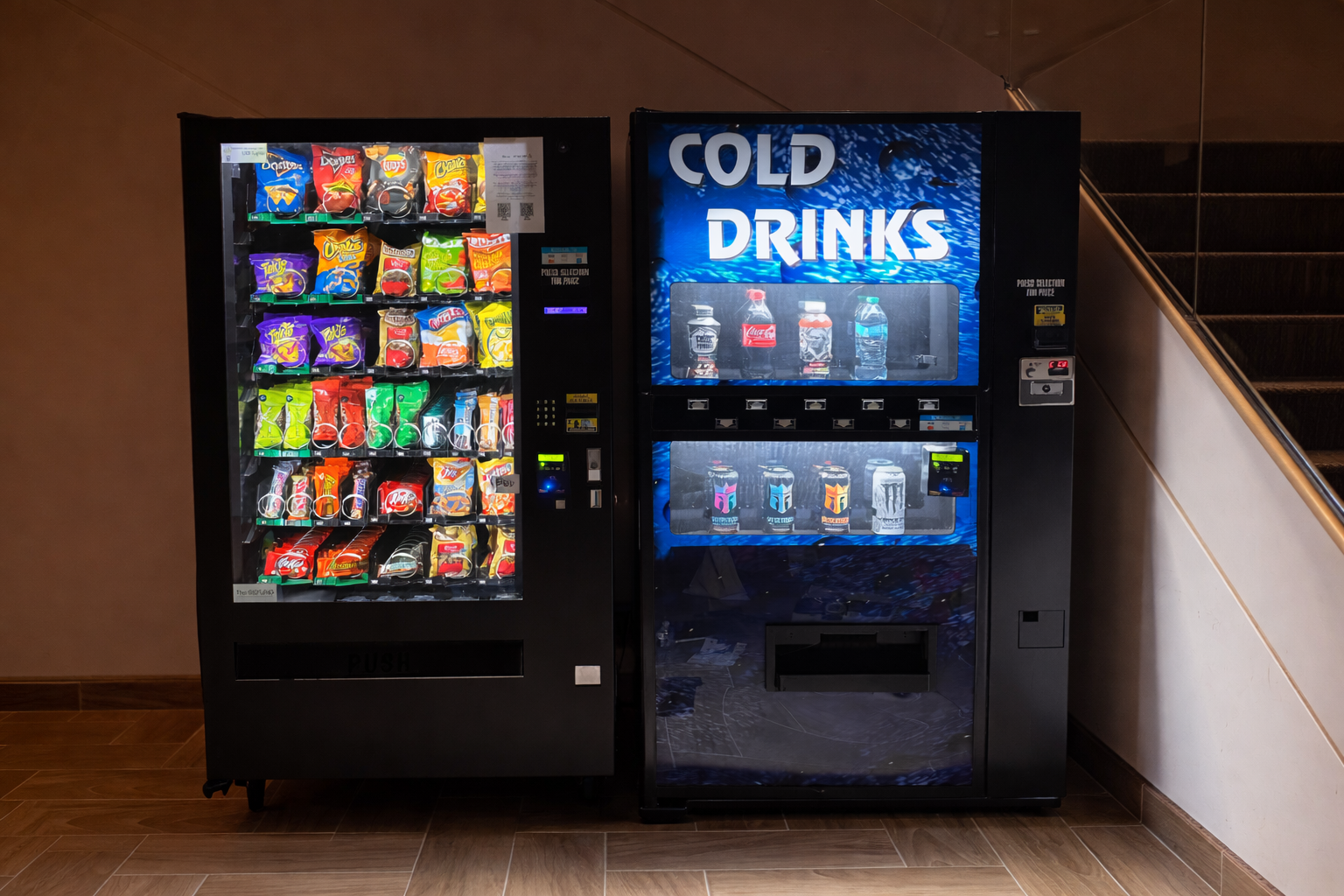
Two machines, same location: a multi-tenant office building with a shared break room area and people from 4-5 different companies walking past the machines throughout the day. One drink machine (bottles: water, Gatorade, energy drinks, coffee products) and one snack machine (chips, candy, protein bars, pastries). All cashless through Cantaloupe with Seed Live for telemetry, and I track product-level costs and margins in VendSoft alongside a spreadsheet that I probably should've consolidated months ago.
Total investment to get started was a few thousand, not tens of thousands: machines, initial inventory, dolly and transport, card readers, and setup. I'm not going to quote an exact number because it varies wildly depending on whether you buy new or refurbished, what condition the equipment is in, and what your location situation looks like (some buildings want you to sign agreements, some just want a handshake and a promise that you'll keep the machines clean).
Eight months of numbers
Over the full run (July 2025 through February 2026) the two machines did $30,513 in total revenue across 10,556 transactions and 11,020 items sold, for an average transaction of $2.89. The blended gross margin across everything (snacks, drinks, candy, coffee) landed at 60%, though that number hides a lot of variation between categories that I've written about in detail in how to calculate vending profit margins.
The headline that surprised me most: the snack machine nets more profit than the drink machine despite generating less revenue, because snack COGS are fundamentally lower. A bag of chips might cost 20-70 cents while a bottle of Starbucks Double Shot costs $2.67. Revenue and profit tell very different stories in this business, and if you're only looking at one of them you're making decisions with half the picture.
Weekly revenue during the busy months (August through November) ran between $1,200 and $1,650 pretty consistently, with a peak of $1,778 in early November. Holiday weeks dipped to $1,000-$1,300 which I'd expected; office foot traffic drops when people take time off. What I did not expect, however, was what happened in January.
Monthly Revenue — Jul 2025 to Feb 2026
The tenant departure
This is the part of the story that I think every vending operator needs to internalize, because it's the kind of risk that's easy to dismiss as unlikely until it happens to you.
Through the fall the operation was humming. Consistent $1,200+ weeks, good sell-through across most products, enough data accumulating that I could start making informed decisions about which slots were underperforming and what to swap in. I was feeling good about the trajectory and starting to think about adding machines at a second location.
In mid-January the largest tenant in the building moved out.
Weekly revenue dropped from $1,144 to $37. Not a typo. Thirty-seven dollars in a week on two machines that had been doing over a thousand. The building went from a full break room with steady foot traffic throughout the day to a mostly empty hallway with maybe a handful of people walking past the machines.
The math on concentration risk in vending is brutal and it's completely binary: your revenue is a function of foot traffic, and your foot traffic is a function of factors that are entirely outside your control. A lease expiration, a company relocating, or a building getting sold can effectively zero out a location overnight. If I'd had one machine in this building and one machine somewhere else, I would've lost half my revenue instead of 97% of it.
What I should have done differently: I should have been watching daily data, not weekly. The foot traffic decline would've been visible in the first 2-3 days if I'd been paying attention to daily sell-through rates (which is something I talk about in tracking vending sales without spreadsheets). Instead, I was looking at weekly summaries and by the time the weekly number came in, the damage was already done. I could've started scouting replacement locations a week earlier, and when you're talking about negotiating building access and getting machines placed, that week matters.
What I'm doing now: actively looking for a second location, ideally in a different building type entirely (maybe a gym or apartment complex rather than another office building) so the revenue streams aren't correlated. Parlaying each new location to capture another reduces your concentration risk and builds a more resilient operation; it's the same basic portfolio diversification logic that applies to any business.
Product selection: what I learned the expensive way
I'm not going to repeat the full margin analysis here because I've already done that in the margins guide, but the product selection lessons are specific to this article because they're about the decisions, not the math.
The best decision I made was stocking Takis from the beginning despite it seeming like a niche product for an office environment. It became my best overall performer (highest margin at volume), and I never would have predicted that from looking at the building demographics on paper. The second-best decision was keeping Quest protein chips and bars in the machine even though their individual margins are mediocre (36-50% range), because the person buying Quest is almost always also buying a C4 energy drink, and the combined transaction justifies the slot. You're optimizing baskets, not individual SKUs; it's not that different from how the shaving industry works, where the starter kit runs at a low margin specifically to lock in the high-margin replacement blade sales.
The worst decision was over-indexing on premium coffee products. Starbucks Double Shot is my highest revenue-per-unit item at nearly $5, which looks fantastic on the revenue report and mediocre on the profit report because of the $2.67 COGS. I also initially stocked three different energy drink variants competing with each other for essentially the same customer instead of diversifying across different buyer profiles, which is like a convenience store putting three brands of orange juice on the shelf and wondering why none of them sell well.
The framework I've settled on for product selection: walk into the building, look at who actually works there, and build product mixes for those people rather than for "an office." In our building there were roughly three groups: the fitness-conscious buyer (Quest, C4, water), the regular snacker (Takis, Doritos, Coke), and the morning coffee person (Starbucks, Little Bites). Each group should have 3-5 products that work together as a basket, and you're stocking for the basket, not for any individual item.
For pricing, I scope what the nearby convenience stores charge: Walgreens, CVS, and gas stations within walking distance. They have dramatically more data on local pricing than I do, and their prices are effectively the ceiling for what people in that area expect to pay. If the Walgreens next door sells a Gatorade for $2.79, I'm not going to price mine at $3.50 and wonder why it sits there.
What I'd tell someone starting out now
Start with one machine. I did two from the beginning and it worked out fine, but one machine lets you learn the product selection process, the restocking rhythm, and the data-checking habit with less capital at risk. You're going to make mistakes in your first few months: stocking too much of something that doesn't move, pricing something too high or too low, or not checking on the machine often enough. It's better to make those mistakes on one machine's worth of inventory than two.
Get cashless from day one. In 2026, the majority of transactions are card or phone, and a cash-only machine is just leaving money sitting in people's pockets that they'd happily tap a card for. Cantaloupe or Nayax both work for this and I've written about the differences and trade-offs between them.
Track your costs from week one, not month three. I waited too long to properly track COGS and it meant I was making product decisions based on revenue alone, which is like running a business by looking at your bank deposits without ever looking at your bank withdrawals. Even a basic spreadsheet with product cost and sell price gives you more actionable information than a beautifully designed telemetry dashboard that only shows revenue.
Diversify locations as soon as it's practical. My biggest regret from these eight months isn't a product mistake or a pricing mistake; it's having both machines in one building. The tenant departure proved that in a way I can't argue with.
Watch your data daily. Doesn't have to be an hour; a 2-minute check in the morning to see if anything looks weird will do. The tenant departure would've been visible on day one if I'd been checking daily instead of weekly, and that earlier signal would've given me time to react before a full week of near-zero revenue had already happened. The trick is making that daily check easy enough that you actually do it; this is harder than it sounds when the data lives across multiple portals and a spreadsheet that's always one update behind reality.
And honestly, the business is fun. I genuinely enjoy speculating on product selection, figuring out what a specific location wants, then seeing whether my hypothesis matches reality. That analytical side of vending (what sells where, how products pair together, where the margins actually are versus where you'd assume they are) is where it gets interesting. It's also the part that gets overwhelming fastest if you don't have a system for it because the number of variables multiplies with every machine you add and every product you rotate. But if you like that kind of problem-solving, you'll like this business.
Frequently Asked Questions
How much does a vending machine make per month? At our location during the active months (August through December), the two machines combined were doing roughly $5,000-$7,000/month in revenue, or about $1,200-$1,650/week. At 60% blended margin that works out to roughly $3,000-$4,200/month in gross profit before expenses like fuel, machine maintenance, insurance, and software. These numbers are completely location-specific, though; foot traffic is the single biggest variable and it varies enormously between a busy office building and a quieter location.
How many hours per week does a vending machine take? At two machines in one location I spend 2-4 hours per week total: restocking (maybe 45 minutes per visit), checking data, and occasional maintenance like unjamming a slot or cleaning the card reader. Most of my time honestly goes to the data and planning side, which I enjoy and probably over-invest in relative to what's strictly necessary. At higher machine counts with multiple locations, route efficiency starts becoming the dominant time factor and that's where software and planning really start to matter.
Is the vending machine business passive income? Not really. It's more like "active income with flexible hours." You set your own schedule, you're not answering to a boss, and the daily time commitment is low relative to most businesses. But the machines need regular attention: products run out, slots get stuck, pricing needs adjusting, and data needs reviewing. Calling it passive sets an expectation that doesn't match reality, and I think that expectation is part of why some people get into vending and then get frustrated when they realize the machines don't literally run themselves.
About the Author
Aidan
Runs a vending business in the Chicagoland area. Building VendCom for independent vending operators.
Learn more →Related Posts
How to Calculate Vending Machine Profit Margins
Revenue isn't profit. Here's how I calculate real margins on every product in my vending machines, with actual numbers from 8 months of data.
How to Track Vending Machine Sales Without Spreadsheets
Spreadsheets fall behind the moment you walk away. Here's what 10,000+ vends taught me about tracking sales, margins, and restocking.
How to Choose Vending Management Software in 2026
An honest breakdown of what vending software actually does, who needs it, and how to evaluate your options without getting oversold.